


According to a recent study by Bupa and Oxford Economics, 58% of founders say poor mental health has affected their ability to lead in the past year. Most recognise what is at stake: 68% say a proactive approach to their own mental health is key to their success. Yet, two in five admit they only take measures to support it once their stress has reached critical levels.
That gap between what founders know and what they actually do is what this piece is about. My aim is to make the case for closing it, for you and for the team you are building around you.
The always-on script
Startups have their own version of the script many of us absorbed in corporate life: if you want to succeed, you live for the work, stay available around the clock and outwork everyone around you. Hustle culture, and an algorithm that keeps serving it to you, can make it look like the only way.
I experienced this first-hand during my years in banking, where pretty much everything was due yesterday. I leaned in fully at the time, but I carried one frustration with me that I still come back to with clients: if everything is urgent, nothing is.
As a startup founder, there is nobody above you to slow things down, so the question of how priorities get set lands squarely on you.
Good stress, and when it tips over
Let me clarify one thing upfront: stress in itself is not the problem. Up to a point, a reasonable degree of pressure can bring out the best in a team, through sharpened focus and greater motivation as ambitious goals are achieved.
The trouble starts when the pressure only builds up, with no release valve. Bruce McEwen and Eliot Stellar coined a term for this in 1993: allostatic load, the cumulative wear and tear the body experiences under chronic stress – the result of compounding pressures that do not leave room to recover. It is different from the “fight, flight or freeze” reaction we have in situations of acute, or short-term stress.
Burnout is what happens at the far end of that road. The World Health Organization describes it as the result of chronic workplace stress that has not been successfully managed – and unlike ordinary stress, a weekend off barely touches it.
However, because allostatic load builds up over time, it gives you a window. The early signals tend to show up well before patches of high stress become chronic and start turning into health problems, so you have time to act on them.
What burnout can look like
Burnout can look different for everyone, which is part of why it is so easy to miss. When I look back at my own lived experience from years ago, by the time I recognised what was happening to me it was already too late. I literally could not get out of bed. My body and mind had been sending warnings for months, and I had pushed through every one of them.
I now know full well that burnout rarely arrives unannounced. Some of the signs worth paying attention to:
- Sleep stops working for you. You wake up as exhausted as when you went to bed, sometimes already light-headed.
- Physical symptoms start to pile up. Tight muscles that never seem to ease, headaches that linger or are already there when you wake up, stomach pain or bloating, or a deterioration in your eyesight.
- You start to pull back. You stop enjoying things you once loved, and connection takes energy you no longer have, so you become quieter and less present.
- Small things trigger big reactions. Irritability, a short temper or tearfulness over something minor is not you being dramatic.
- You stop asking for help. You tell yourself to just get on with it, when the truth is you objectively have too much on.
- You cannot think beyond today. Planning ahead, visioning, even deciding what to have for dinner feels overwhelming.
- You double down on work. This is the counterintuitive one, but many people in burnout work more, not less, because staying busy feels like control.
For founders, the latter is possibly the easiest one to miss, because from the outside it looks exactly like commitment.
The cost of waiting
The cost starts with the founders themselves. In the same Bupa study, 62% had experienced anxiety in the past year, and three quarters said work-related stress had harmed their physical health or sleep – whilst 72% struggled to switch off even during personal occasions.
From there, the impact spreads to teams and to the business as a whole: absenteeism goes up; engagement tanks; creativity and innovation get stifled at exactly the stage a startup most depends on them; retention costs rise as good people leave; experience and knowledge leave the organisation; clients start noticing and leave as a result. Ultimately, this slow erosion can lead to the failure of the business.
Your pace becomes their pace
As a leader, your habits travel fast – and even faster if you are the founder of a startup in its early days, when the team is small. The way you work inevitably becomes the culture everyone else works in.
Research from the think tank Startup Snapshot shows how far this reaches: 80% of startup employees say their job has had an impact on their mental health, and 61% report high stress, yet 90% did not expect startup life to affect them this way.
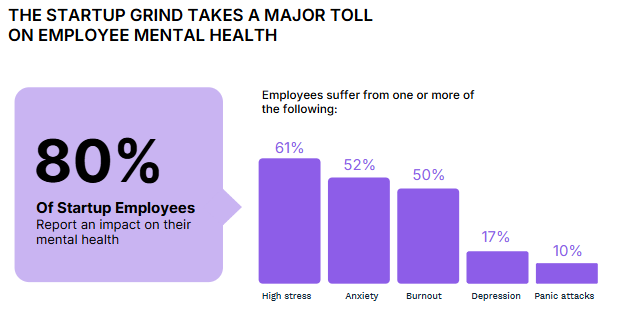
Source: Startup Snapshot (2025) The Untold Toll (Part 2): Navigating Stress, Wellbeing, and Burnout in Startup Teams.
Nearly three in five (57%) see their founder expressing stress or anxiety at least a few times a month, with those working for highly stressed founders reporting 14% higher burnout rates than those whose founders have low stress.
It works the other way too, by the way. The same study reports that 37% of employees join a startup because of an inspiring founder. A team absorbs the founder’s light as well as the stress – when you model a sustainable way of working, you give everyone else permission to do the same.
Where to start
Closing the say-do gap does not need a grand overhaul. Here are a few places to begin:
- Know your early warning signs. Regularly check-in with yourself to notice how you are really doing, rather than waiting for a crisis to tell you.
- Design recovery in upfront. Elite athletes build planned recovery into their training, because that’s when adaptation happens. For a founder, that might be a consolidation period after a funding round, a lighter week after a product launch, or meeting-free days for focus time.
- Set boundaries, and say them out loud. They protect your ability to keep showing up, and they set the tone for your team. When you are clear about what works for you and what does not, you give everyone around you permission to do the same, and people tend to respect you more for it, not less.
- Let go of knowing it all. Be honest about your gaps, bring people onto the team who know more than you in those areas, and then let them get on with it. Delegating well is one of the most effective ways to manage your own stress.
- Invest in yourself without guilt. Doing what helps you function at your best (be it a gym membership, a desk-free lunch break, a massage, a coach or a therapist) is not self-indulgent – it is what makes everything else possible.
None of this means giving up on ambition. There will be phases where you have to lean right in – but taking care of your own wellbeing is as important if you want to make your founder journey a sustainable one for yourself, and those around you.
The long game
Building a startup is a long game. The founders who last are rarely the ones going fastest – they are the ones who have worked out how to keep going, and who have built a team that can keep going with them. Looking after yourself is how you stay in the game long enough to build what you set out to build.
How I can help
My name is Valeria Collu and I am the founder of Coaching Stream, where I support leaders to perform at their best without burning out. I am accredited as an EMCC Practitioner and trained as a Mental Health First Aider, and I have lived through my own experience of burnout and recovery. As a Strengthscope® Practitioner, I also help teams understand how each person can perform at their best, and how they can better collaborate under pressure.
I work with founders and leaders in a few ways:
- 1:1 coaching to protect their energy and decision-making when pressure is high, creating the conditions for the team and business to thrive
- Support for first-time managers as you scale, so your best people are ready to move from doing the work, to leading others through it
- Practitioner-led training for your team, on skills such as delegation, giving feedback and handling difficult conversations
- Team sessions designed to bring people closer together, from strengths-based work using Strengthscope® to team offsites
If you’d like to have a conversation about what sustainable performance could look like for you and your team, I offer a free, no-obligation call which you can book here.
References
Bupa (2025) ‘Seven in ten founders say “always on” mental health approach is key to success’, press release, 20 November. Research conducted with Oxford Economics. Available from: https://www.bupa.com/news-and-press/press-releases/2025/seven-in-ten-founders-say-always-on-mental-health-approach-is-key-to-success
McEwen, B.S. and Stellar, E. (1993) ‘Stress and the individual: mechanisms leading to disease’, Archives of Internal Medicine, 153(18), pp. 2093–2101.
Startup Snapshot (2025) The Untold Toll (Part 2): Navigating Stress, Wellbeing, and Burnout in Startup Teams. Available from: https://www.startupsnapshot.com/research/employee-wellbeing/
World Health Organization (2019) ‘Burn-out an “occupational phenomenon”: International Classification of Diseases’, news release, 28 May. Available from: https://www.who.int/news/item/28-05-2019-burn-out-an-occupational-phenomenon-international-classification-of-diseases
Author: Valeria Collu