

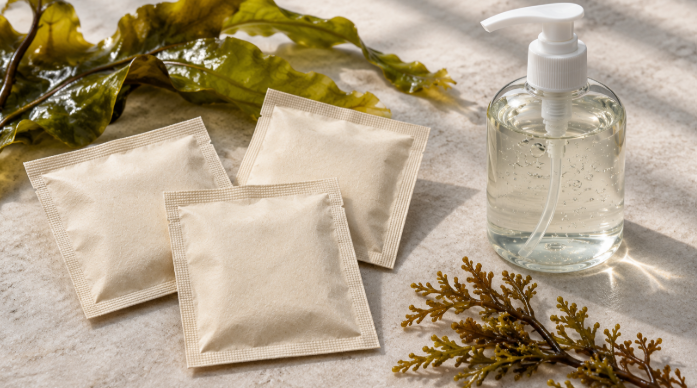
Three UK companies have taken a seaweed-derived packaging material beyond laboratory development, manufacturing paper sachets for liquid hand-wash samples using existing production equipment.
A Real-World Test for Liquid Packaging
On 17 September 2026, Bristol-based biomaterials developer Kelpi and household-care brand Bower Collective announced a limited-edition launch of seaweed-coated paper sachets for liquid hand wash.
The launch followed a manufacturing run by UK sachet producer Guardpack. Bower confirmed that selected customers received samples, demonstrating customer-facing deployment rather than mass-market adoption.
Each sample pack contained three 5 ml sachets. According to Bower, the paper incorporates a barrier coating developed by Kelpi using seaweed-derived sugars and plant oils.
The coating is designed to allow paper packaging to contain liquids without the conventional fossil-derived plastic lining used in many multilayer sachets.
Manufacturing Compatibility Demonstrated
Liquid sachets present substantial technical challenges. Packaging must resist leakage, withstand filling and sealing, and remain compatible with the formulation inside.
Guardpack confirmed that it manufactured and filled the coated-paper sachets during a production run on 14 September 2026.
The company reported that its existing sachet-filling machinery required no physical modifications.
However, the process highlighted the importance of controlling sealing temperature and dwell time, alongside coordinating sachet formation, filling speed and liquid viscosity.
These findings demonstrate manufacturing feasibility for the tested application, but not universal compatibility with other formulations.
Guardpack says further product-specific compatibility and shelf-life validation will be necessary for wider applications.
Recyclability and Environmental Considerations
Kelpi states that the coated-paper sachets are suitable for household paper recycling.
However, this supplier claim does not independently establish acceptance by every local recycling collection scheme or confirm actual recycling rates.
The sources reviewed also do not establish, through a comparative life-cycle assessment, that the complete packaging system has a lower overall environmental footprint than conventional alternatives.
The companies describe the sachets as avoiding a fossil fuel-derived plastic lining. This distinction should not be interpreted as proof of universal recyclability, environmental biodegradability or zero environmental impact.
From Biomaterials Research to Customer Trials
The significance of this collaboration lies in its practical progression: a seaweed-derived coating was applied to paper, processed through existing manufacturing equipment and used for real customer samples.
For biotechnology and biomaterials developers, it illustrates the importance of validating innovations within established industrial processes.
The next milestones will include repeatable production, verified shelf life, compatibility with additional formulations and sustained commercial demand.
Kelpi, Bower Collective and Guardpack have demonstrated a credible route from biomaterials development to market-facing trials. Whether the technology achieves widespread commercial adoption remains to be established.