

Every successful innovation begins with an idea, but turning that idea into a commercially successful business requires far more than great technology.
For most startups, one of the biggest challenges is securing the resources needed to develop, validate and scale their innovation.
While access to capital remains challenging, there has never been a better time for innovative businesses to seek public funding. Across the UK and Europe, billions are invested each year through programmes such as Innovate UK, Horizon Europe, the European Innovation Council (EIC) and Eureka, helping startups and SMEs de-risk innovation, develop new technologies and accelerate their journey to market.
Yet funding has never been more competitive. Technical excellence alone is no longer enough. Assessors increasingly look beyond the innovation itself, seeking evidence that a business understands its market, has a credible route to commercialisation and can deliver meaningful economic or societal impact.
For ambitious startups, understanding how the funding landscape works can become a genuine competitive advantage.
One of the questions I am asked most often by founders is, “Which grant should we apply for?” It’s a perfectly reasonable question, but it is rarely the best place to start.
The strongest businesses don’t begin by looking for funding. They begin by understanding the problem they are solving, the customers they want to serve and the value their innovation will create. Once those fundamentals are clear, identifying the right funding opportunity becomes much easier.
Having spent more than twenty years supporting innovative businesses and evaluating funding proposals, I have found that the strongest applications consistently have a number of characteristics in common.
Start with the problem, not the funding
Funding should support an innovation strategy—not determine it.
Too often I see businesses searching for a grant before they have clearly defined the problem they are trying to solve. A well-defined problem statement not only strengthens a funding application, it also provides the foundation for a stronger commercial strategy.
The strongest applications demonstrate a deep understanding of customer needs, market opportunity and the value the innovation will create. When those foundations are in place, selecting the right funding programme becomes far more straightforward.
Choose the right programme
Not every funding opportunity is intended for every type of innovation or stage of development.
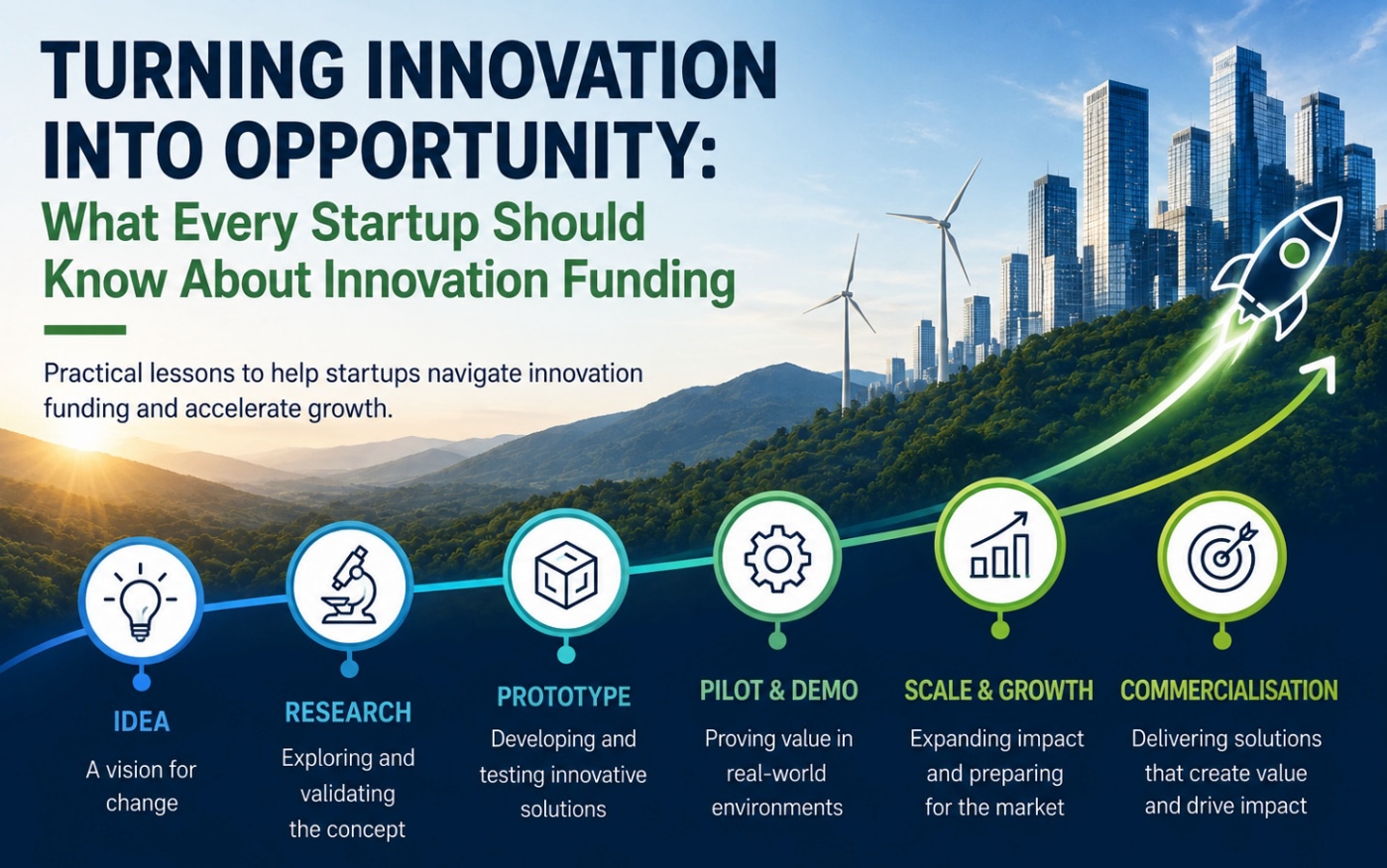
Some programmes support early-stage research, while others focus on prototype development, industrial demonstration or commercial scale-up. Understanding your technology’s stage of development is essential to choosing the programme that offers the greatest chance of success.
Applying to the wrong programme can be just as damaging as submitting a weak application.
Evidence builds credibility
Whether you’re approaching public funders or private investors, evidence builds confidence.
Technical validation, customer engagement, intellectual property, regulatory planning and commercial analysis all demonstrate that an innovation has progressed beyond an interesting idea towards a credible business opportunity.
The strongest companies begin building this evidence long before an application deadline appears on the calendar.
Think beyond the grant
The most successful businesses don’t see grants as the destination—they see them as a catalyst for growth.
Innovation funding should accelerate technology development, strengthen partnerships, attract investment and build market credibility. Organisations that gain the greatest long-term benefit are those that use grant funding as part of a wider commercial strategy rather than an objective in itself.
Preparation makes the difference
The strongest proposals are rarely produced in a matter of weeks.
Behind every successful application is careful planning, a compelling technical and commercial story, robust supporting evidence and realistic project planning. Starting early provides time to refine the proposition, strengthen partnerships and build the confidence that evaluators look for.
In my experience, the highest-scoring proposals are rarely the result of last-minute writing. They are developed over months, with time invested in refining the innovation, validating the market opportunity and building the right consortium or commercial partnerships.
Looking ahead
Innovation has always been one of the most powerful drivers of economic growth and societal progress.
Whether the challenge is improving healthcare, accelerating the transition to net zero, advancing manufacturing or enabling digital transformation, startups have an increasingly important role to play in shaping the future.
Funding is only one part of that journey. Long-term success comes from combining a strong innovation with a clear commercial vision, compelling evidence and the right strategic partnerships.
For startups prepared to invest the time in developing a compelling innovation story, funding can provide far more than financial support—it can become the catalyst for long-term growth, strategic partnerships and international success.
About the Author
Dr Robin McIntyre MRSC is Director of RCM Innovation Ltd, an independent consultancy specialising in innovation funding strategy across the UK and Europe. Over the past 20 years he has supported companies, universities and research organisations in securing more than €130 million in European funding and over £20 million from UK innovation programmes. As a European Commission Expert Evaluator, MSCA evaluator and Innovate UK assessor, he brings an evaluator’s perspective to proposal development, helping organisations transform innovative ideas into funded, commercially successful projects.